
Why Your Small Business Needs a Content Marketing Strategy (And How to Build One)
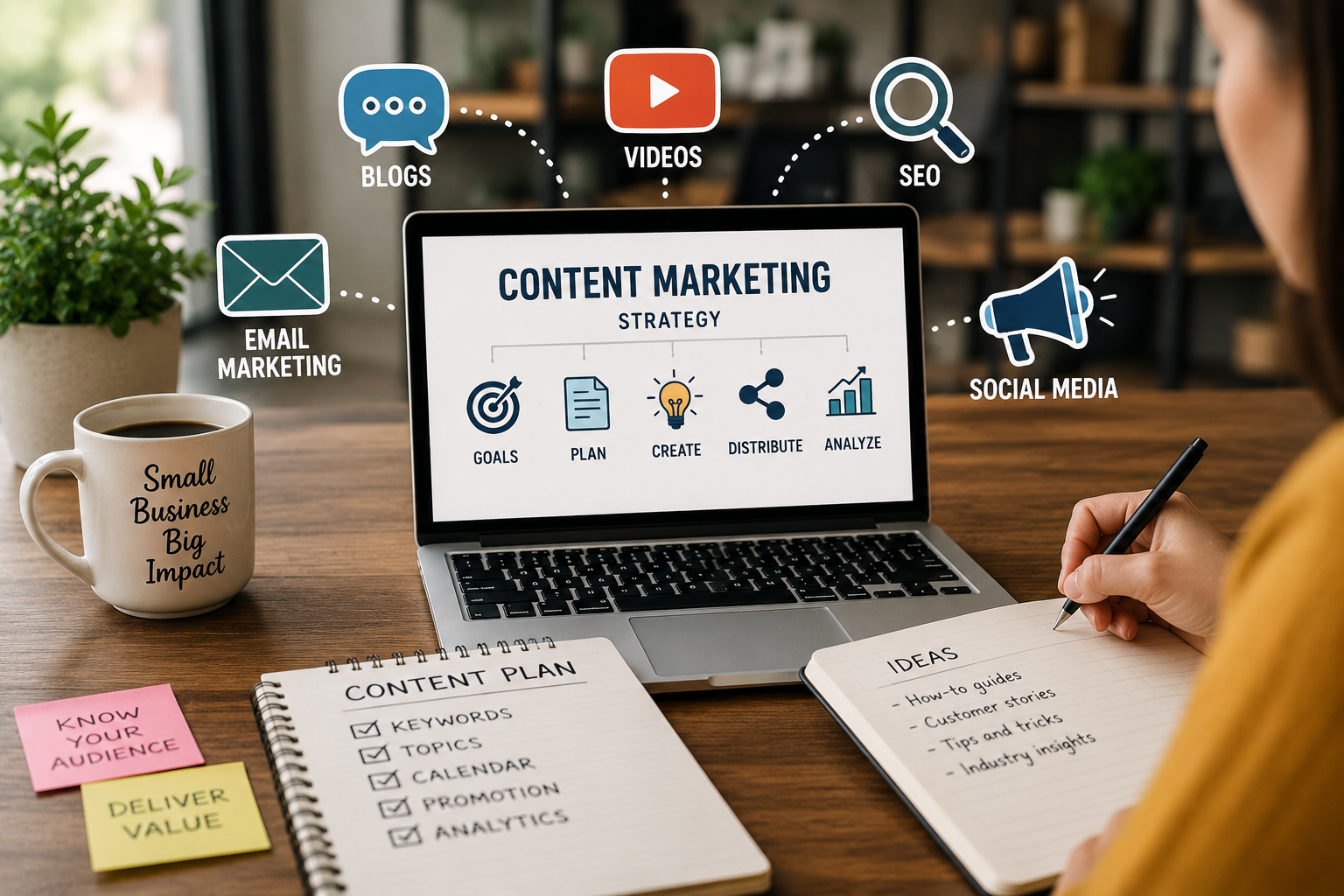
If you run a small business, you’ve probably heard that “content is king.” But in 2025 and 2026, the reality is more nuanced: content is the engine — and strategy is the steering wheel.
Here’s what the data says:
- 58% of B2B marketers reported increased sales and revenue in 2024 directly due to content marketing.
- Blog posts remain among the top 5 highest-ROI content formats according to marketers.
- Businesses using AI for content marketing see an average of 70% increase in ROI.
- 50% of buyers read a company’s blog when making purchase decisions.
Yet most small businesses don’t have a content strategy — they post sporadically on social media and wonder why it doesn’t work. This guide will change that.
Why Content Marketing Matters More Than Ever
1. It’s the Foundation of SEO
Every blog post, service page, and case study you create is an opportunity to rank in search. Google prioritises websites that publish fresh, relevant, and authoritative content. Without content, you’re invisible to search engines.
2. It Builds Trust Before the Sale
Customers research before they buy. When they land on your website and find helpful, well-written content, they trust you. That trust translates directly into conversions.
3. It Compounds Over Time
Unlike paid ads that stop working the moment your budget runs out, a well-optimised blog post can drive traffic for years. One article written today could still be bringing you leads in 2028.
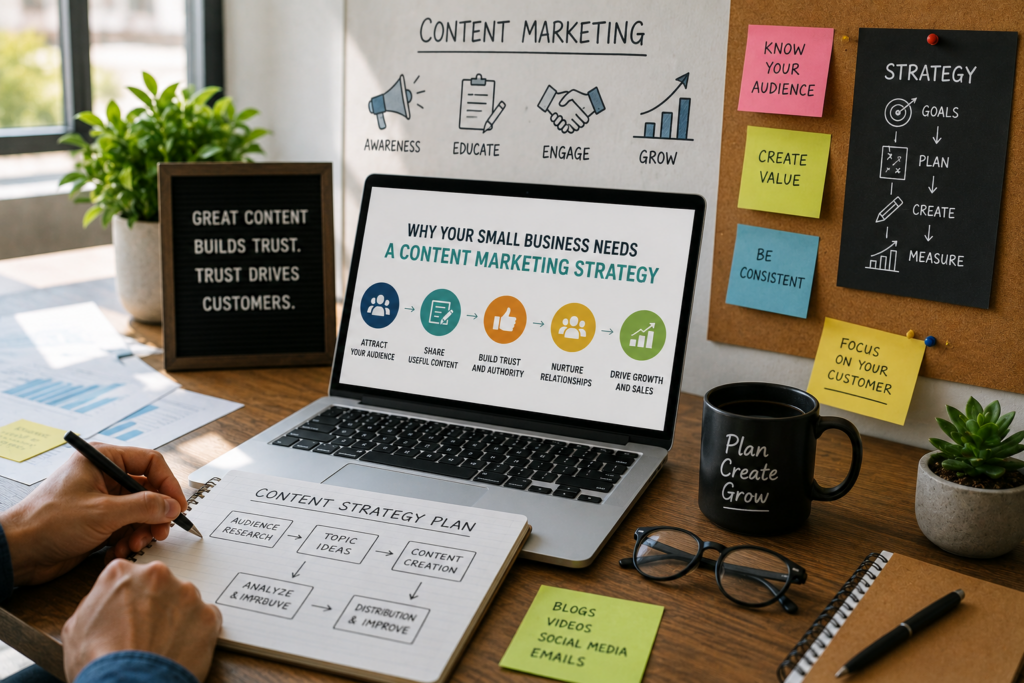
How to Build a Content Marketing Strategy in 5 Steps
Step 1: Define Your Audience and Goals
Before you write a single word, get crystal clear on two things:
Who are you writing for?
- Existing customers you want to upsell?
- New customers discovering your category for the first time?
- Decision-makers at other businesses (B2B)?
What do you want them to do?
- Book a consultation?
- Buy a product?
- Subscribe to a newsletter?
Create one sentence: “I want [audience] to [action] by giving them [value].”
Step 2: Find Topics Your Customers Are Actually Searching For
Don’t guess. Use data:
- Google Search Console: See what queries already bring people to your site.
- AnswerThePublic: Discover the exact questions people are asking.
- Keyword research tools: Identify high-intent, low-competition keywords relevant to your business.
Rule of thumb: Create content for keywords where searchers have commercial intent — “best [service] in [city],” “how to choose [product],” “[service] cost in India.”
Step 3: Create Content That’s Actually Useful
The internet is drowning in generic, AI-generated fluff. To stand out, your content needs to be:
- Actionable — Can someone DO something after reading it?
- Specific — Use real examples, numbers, and data.
- Authentic — Write like a human who knows their craft.
The 80/20 rule: Spend 80% of your time on research and structure, 20% on writing. Quality beats quantity every time.
Step 4: Distribute Your Content
Creating content without a distribution plan is like opening a restaurant with no signboard.
| Distribution Channel | Best For |
|---|---|
| SEO / Google Search | Long-term organic traffic |
| Email newsletter | Nurturing existing leads |
| LinkedIn (B2B) | Professional authority building |
| Instagram (B2C) | Visual storytelling |
| Paid promotion | Accelerating reach for high-value content |
The multiplier effect: Promote each new piece of content across at least 3 channels. A blog post can become an email, a LinkedIn post, 3 Instagram slides, and a 60-second video.
Step 5: Measure, Learn, Repeat
Track what matters:
- Traffic — Is this content bringing people to your site?
- Engagement — Are people reading, sharing, and commenting?
- Conversions — Are readers taking the action you wanted?
Double down on what works. Cut what doesn’t. Content marketing is a flywheel — it gathers momentum over time.
A Realistic Small Business Content Calendar
| Week | Content | Distribution |
|---|---|---|
| 1 | Blog post: “How to Choose [Your Service]” | SEO + LinkedIn + Email |
| 2 | Social version: 5 Instagram slides from the post | Instagram + Facebook |
| 3 | Blog post: Case study / client story | SEO + LinkedIn |
| 4 | Roundup: “3 Tools Every [Industry] Pro Should Know” | LinkedIn + Email |
That’s 4 hours per week for content that compounds into months of visibility.
How Luxelane Media Can Help
Not every small business owner has time to write blog posts, shoot videos, and manage distribution. That’s where we come in.
Our content marketing services include:
- SEO-optimised blog writing tailored to your business
- Social media content calendars and execution
- Photography and videography for your brand
- Performance tracking and monthly reporting
We help startups and established businesses in Kerala and beyond build content strategies that actually deliver leads.
Let’s build your content engine →
